Fresh data. Any SQL. No recomputation.
Feldera is an incremental view maintenance (IVM) engine that maintains any SQL query on fresh data - in milliseconds, at any scale, at a fraction of the cost.
Built on DBSP theory (Best Paper, VLDB '23), it's the only engine that incrementally maintains any SQL, including hundreds of joins, recursive queries, and sliding windows, with the exact same correctness guarantees as your warehouse.
Show us your hardest pipeline. We'll prove it in 30 minutes.
Book a 30-minute demo
Tell us where to reach you, then pick a time that suits you.
Trusted by leading engineering teams









Feldera’s IVM engine is best in class — it is, without any exaggeration, rock solid. It’ll blow your mind — DBSP incrementalizes ANY SQL query you throw at it — ANY query, even if you have a bazillion JOINs and a thousand GROUP BYs.

Raki Rahman
Principal Software Engineer, SQL Server · Microsoft

Securing AI agents at scale isn’t easy. Our customers include some of the most security-conscious organizations out there, and they expect rock-solid performance. Feldera helps us deliver on those expectations.

Graham Neray
CEO & Co-Founder · OSO
Feldera is a game changer for building the highest value real-time fraud and feature engineering pipelines. Easy to use (it’s SQL) and state of the art in performance.

Jim Dowling
Co-Founder & CEO · Hopsworks
See how incremental view maintenance works
We help data engineering teams eliminate wasteful recomputation
Built to enable modern products
What teams actually build when data updates in milliseconds instead of hours

Real-time data pipelines
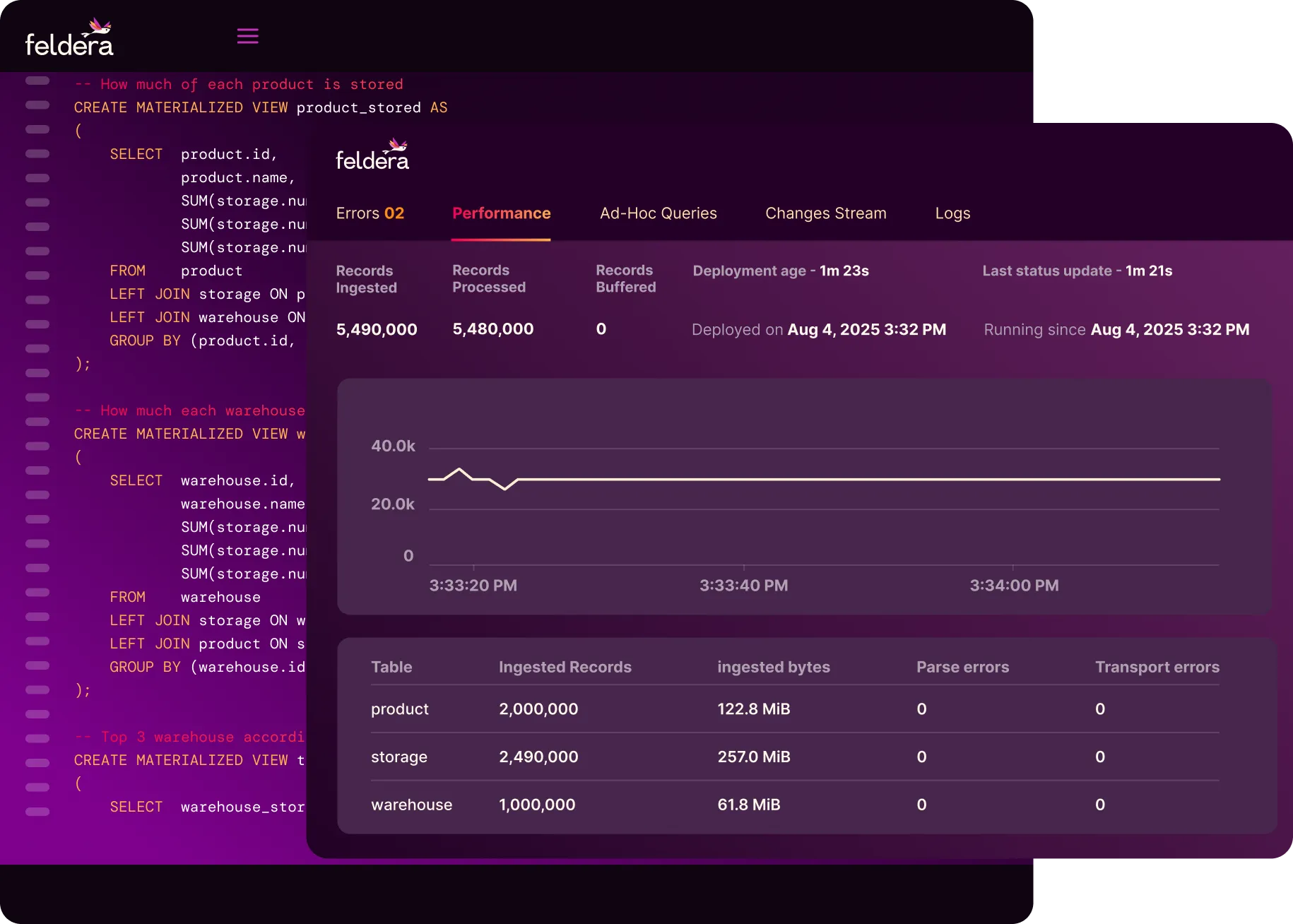
Most data pipelines recompute everything on every run, even though less than 0.1% of the data changed. Feldera runs your existing SQL incrementally, with no orchestration code and no scheduled batch jobs. What used to take a 70-node cluster now runs on 2 nodes.


How Feldera compares
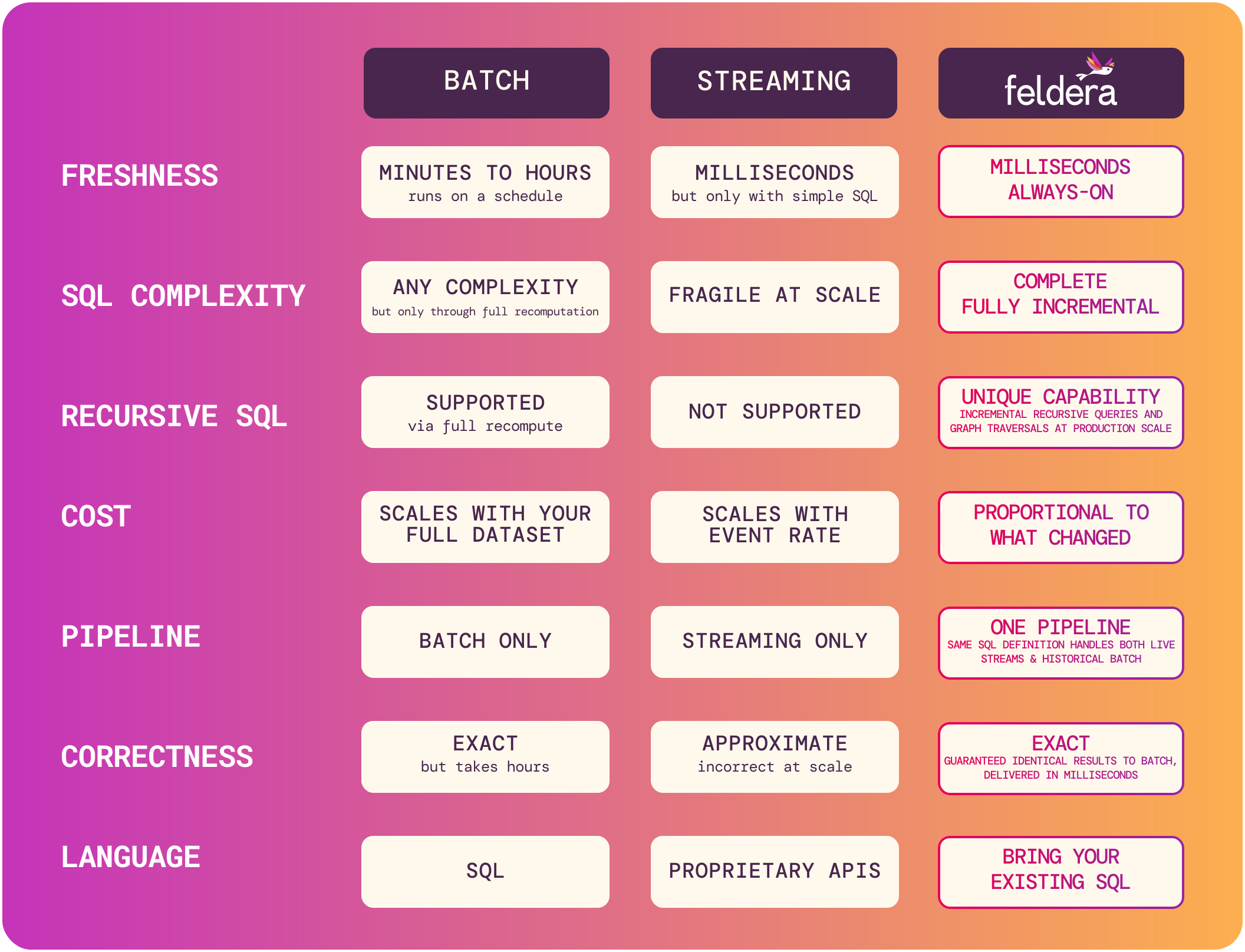
Batch vs. Streaming vs. Feldera
We love to share how we built Feldera
Read about the theory, customer results, the engineering challenges, and more.
 Proof
ProofCan Your Incremental Compute Engine Do This?
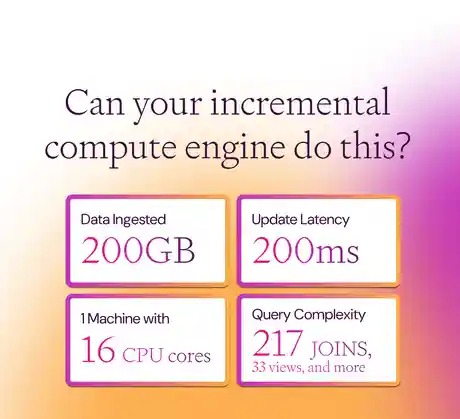
A real customer pipeline: 217 join operators, 33 output views, 250 million rows ingested from Delta Lake. After backfill, incremental updates run in ~200ms on a single machine using 15GB of RAM at steady state. Mihai (Chief Scientist/Co-Founder) shows the query plan and the numbers.
 Batch
BatchImplementing Batch Processes with Feldera
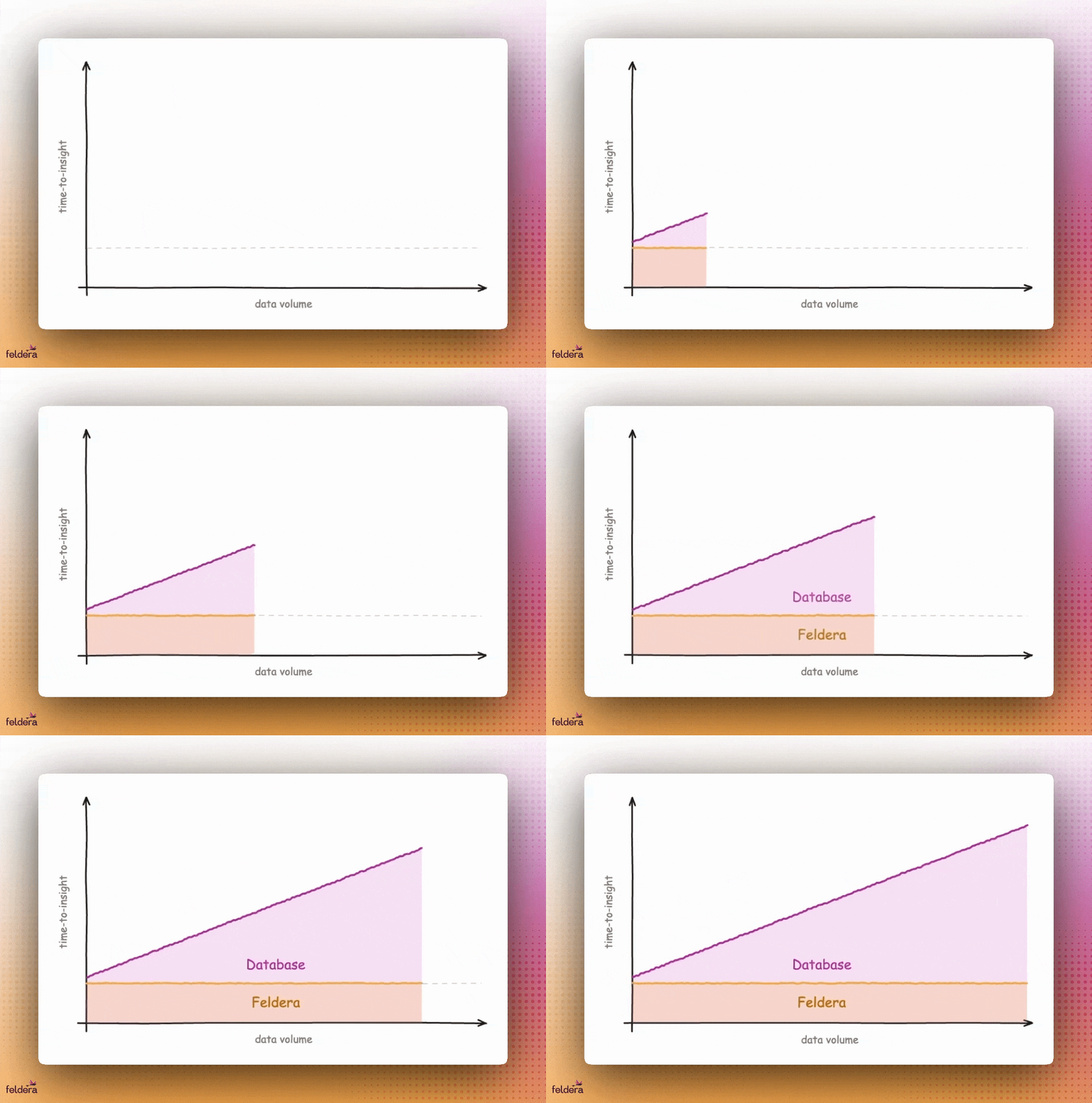
Side-by-side TPC-H benchmark: a traditional database slows down with every batch as data grows. Feldera stays flat, 170 seconds per batch, every batch, regardless of total data size. Ben (Chief Engineer/Co-Founder) shows the trend lines.
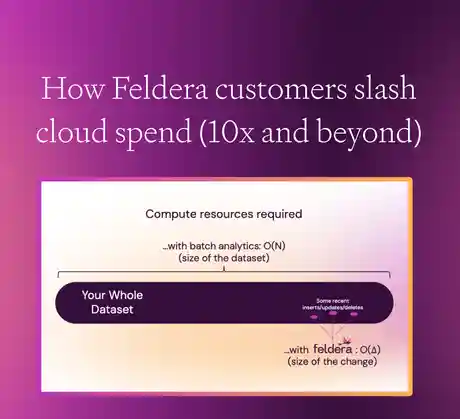 COST ANALYSIS
How Feldera Customers Slash Cloud Spend (10x and Beyond)
Why your compute bill scales with your data size instead of your data changes, and the math that fixes it. Includes a real case study: hundreds of thousands of lines of SQL migrated from a 70-node Spark cluster to one or two Feldera nodes, with views updating in milliseconds.
 AI + AGENTS
Agents Aren't Coworkers, Embed Them in Your Software
Most agent architectures poll, diff, and guess what changed. Feldera's CDC streams give agents precise, incremental updates, so the agent reacts to exactly what changed, when it changed. Gerd (Head of Engineering/Co-Founder) on agentic design patterns and how incremental compute makes agents calmer and cheaper to run.
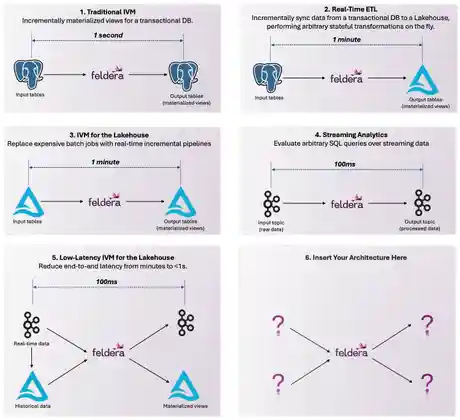 Architecture
Universal IVM: Incremental View Maintenance for the Modern Data Stack
Why no existing IVM system meets the bar, and how Feldera built the first complete one. Leonid (CTO/Co-Founder) walks through the architecture of a general-purpose IVM engine that works across data sources, from classic batch replacement to real-time ETL.
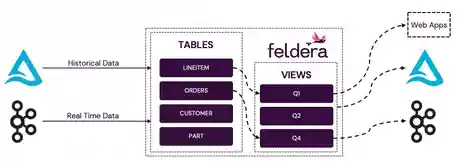 HOW TO
Accelerating Batch Analytics with Feldera
A four-part hands-on guide: create a Spark SQL batch job, convert it to a Feldera pipeline, hook up historical and real-time data sources, and send output to multiple destinations. The exact migration path your team would follow.
Frequently asked questions
Does Feldera replace my lakehouse?
No. Feldera provides incremental view maintenance for your lakehouse. It attaches to Delta Lake, Iceberg and other data sources/destinations, and replaces scheduled batch jobs with always-on incremental pipelines inside your lakehouse. Downstream readers keep reading the same gold tables.
How does Feldera keep bronze, silver, and gold fresh?
You declare the silver and gold transformations as SQL views. Feldera maintains them incrementally: when new data lands in bronze, it computes only the effect of that change and updates the downstream tables in milliseconds, instead of rebuilding them on a schedule.
Are the results correct?
Yes. Feldera produces the same answers your warehouse would return for the same SQL over the same data. The engine is built on DBSP, a formally verified theory of incremental computation and the VLDB 2023 Best Paper, so incremental results do not drift from a full recomputation.
Can Feldera maintain Iceberg tables incrementally?
Yes, through its Iceberg connectors, which are currently experimental. Delta Lake connectors are stable on both the source and the sink side. In both cases the same SQL runs incrementally, so tables update with the change instead of being reprocessed.
Do I have to move my data out of the lakehouse?
No. The lakehouse stays the source of truth. Feldera attaches to it, maintains the derived layers continuously, and writes the results back. Downstream readers keep reading the same tables they read today.
How complex can a Feldera pipeline get?
Monster pipelines are the point. 500+ joins across 40K+ lines of SQL, recursive queries, sliding windows: bring your SQL as-is. One example from production: 217 join operators over 250 million rows, updating in about 200ms on one 16-core machine. However complex the SQL gets, the work tracks the size of the change, not the size of your data. We don’t recompute. Ever.