Experience True Incremental View Maintenance
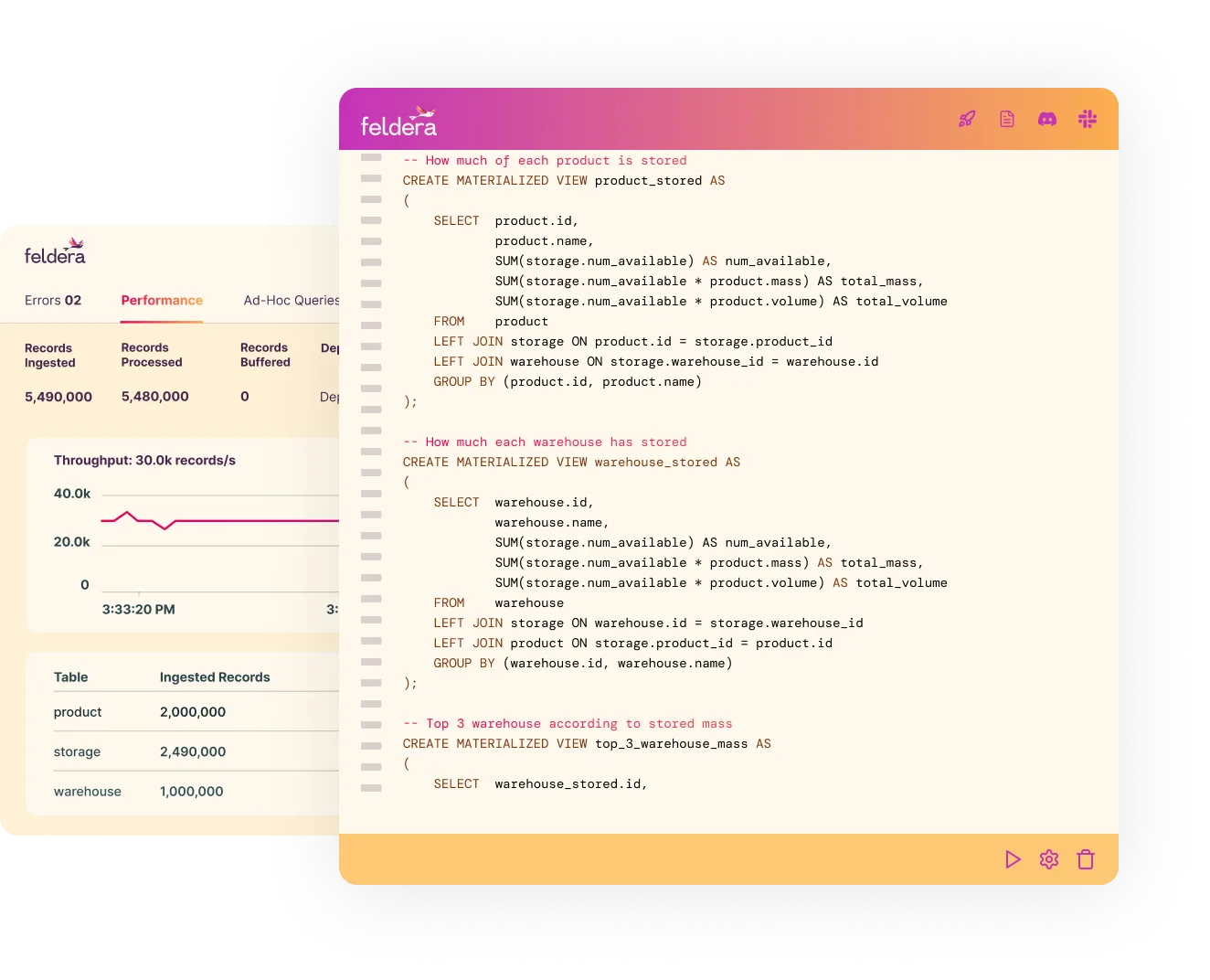
Batch jobs waste 99.9% of their time re-processing data that hasn’t changed. Feldera erases that waste with automatic incremental updates for any SQL pipeline. Process 40K-line SQL pipelines with hundreds of joins and even recursive queries, at millions of changes per second, even on a laptop.
Core platform capabilities
Experience unmatched performance, scale and expressive power for incremental computation use cases.

Powerful
Fully Incremental Compute
- Keep your compute proportional to the size of the "change", not the size of the whole dataset
- Sub-second results when data changes, even over terabytes of data
- Handles complex SQL with mathematically guaranteed correctness

Complete
Full SQL Parity
- Full SQL support including window functions and recursive queries
- Exact same semantics and SQL as your existing batch code -- code changes are rare
- Compare Feldera’s outputs against your existing database or warehouse for row-by-row parity

Resilient
Intelligent Infrastructure Management
- Intelligent scaling using disk and S3 for datasets larger than memory
- Run pipelines with strict least-privilege security and resource controls, fully integrated with Kubernetes
- Resilience via fault-tolerance and checkpointing
Your Cloud, Your Data, Your Rules
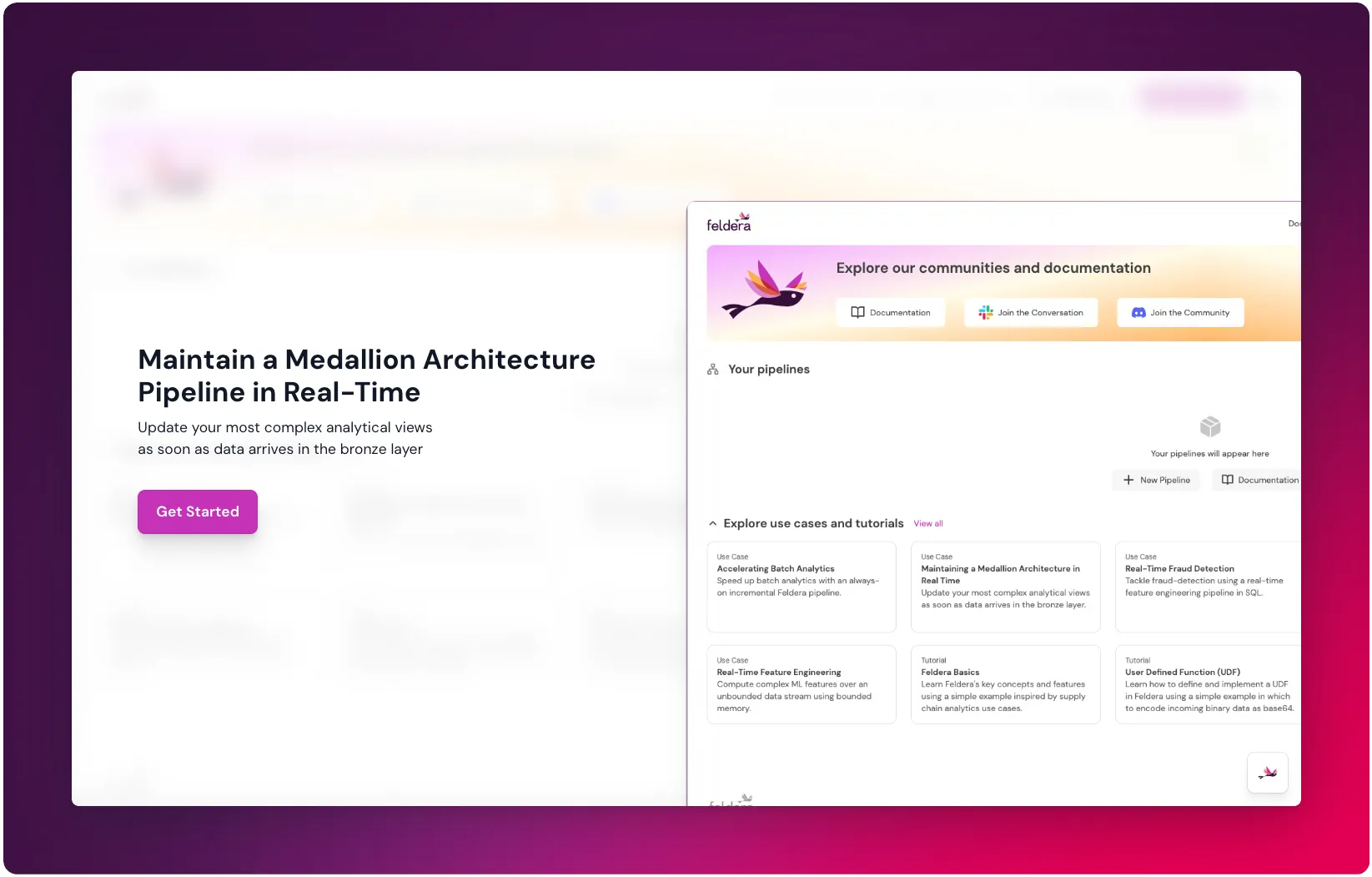
Feldera's Enterprise edition runs fully self-hosted in your environment. Define pipelines in a fully multi-tenant architecture that securely connects and computes over your existing data sources and destinations. All your pipelines, code, configuration and data stays inside your perimeter.
Start building with Feldera
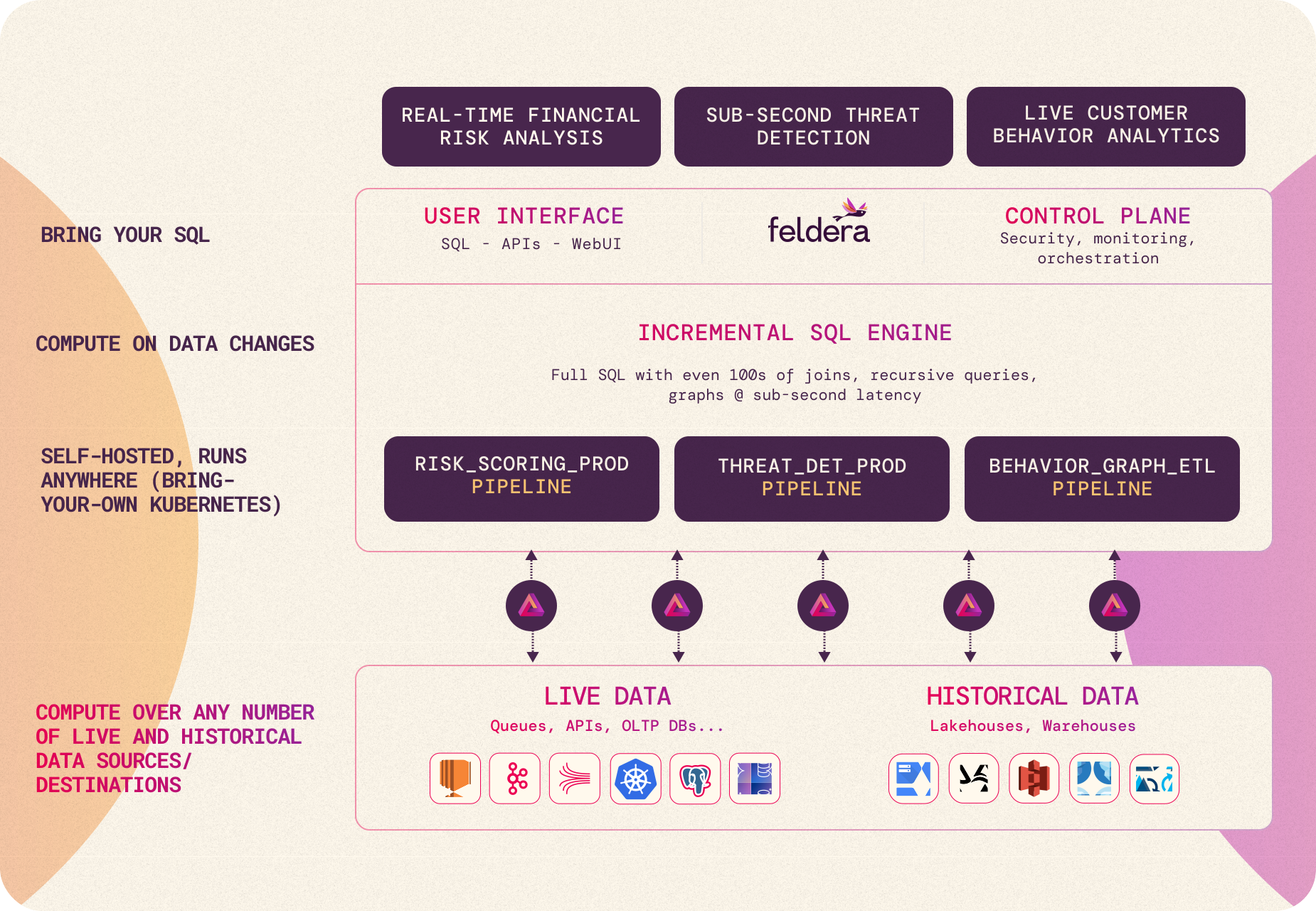
Get started your way: hands-on guides, research deep-dives, community discussions, or bite-sized reads.
Documentation
Learn Feldera from quickstart to advanced use cases.
Research Papers
Explore DBSP, the award-winning research that powers Feldera’s incremental view maintenance engine.
Community
Get help, share ideas, and see what others are building.
Blog
Deep dives on incremental compute, real-world use cases and systems engineering.
Pricing
For developers
Open source edition
Incremental computation for free, with an MIT license
- Single node, single container
- Full SQL support
- All connectors
- Datasets larger than memory
- Support via community Slack
For production use
Enterprise edition
Self-hosted in your own Kubernetes clusters with full multi-tenant isolation
Book a 30-minute demo
Tell us where to reach you, then pick a time that suits you.
- Multi-node deployments, data never leaves your perimeter
- Enterprise SSO, RBAC, OIDC, and secrets
- Per-pipeline compute and resource isolation
- Fault-tolerant scalable pipelines and control plane
- S3-backed persistence and intelligent backfill
- Scale-out backfill across multiple hosts
- Out-of-the-box monitoring integration
- Dedicated support and expert consulting
Contact us
📩 Get in touch to discuss your use case, explore pricing options, or see how Feldera can unlock faster insights for your organization. 👉 Fill out this form, and we’ll get back to you shortly.
Feldera is a game changer for building the highest value
real-time fraud and feature engineering pipelines.
Easy to use (it’s SQL) and state of the art in performance.”
Frequently asked questions
How many joins can Feldera handle?
Where others struggle with 1-2 joins or large scale, Feldera is comfortable doing 500+ joins on 40K+ lines of SQL. One real-world example from production: 217 join operators, left joins included, over 250 million rows, updating in about 200ms on a single 16-core machine. See the real world example
Does Feldera support recursive SQL queries?
Yes. Feldera supports recursive and mutually recursive views through its own DECLARE RECURSIVE VIEW syntax, which is more expressive than standard SQL recursion. Read the docs
Which SQL does Feldera support?
Feldera compiles SQL with Apache Calcite and supports aggregates, joins including outer joins, DISTINCT, window functions, JSON and variant types, arrays, maps, and table functions. Declare a view MATERIALIZED and it becomes queryable state: point ad hoc SQL at it and you get the latest result. Read the docs
Is Feldera open source?
Yes. The open source edition is MIT licensed: single node, full SQL support, all connectors. Enterprise is for production at scale: self-hosted in your own Kubernetes clusters, with multi-node deployments, fault tolerance, disaster recovery, SSO, and RBAC. Your pipelines, code, and data stay inside your perimeter. Try today